How to Include Study Abroad on a Resume (Examples & Best Placement)
How to include study abroad on a resume: best placement, real examples, and ATS tips for students and new grads. Free score at ResumeScorer.
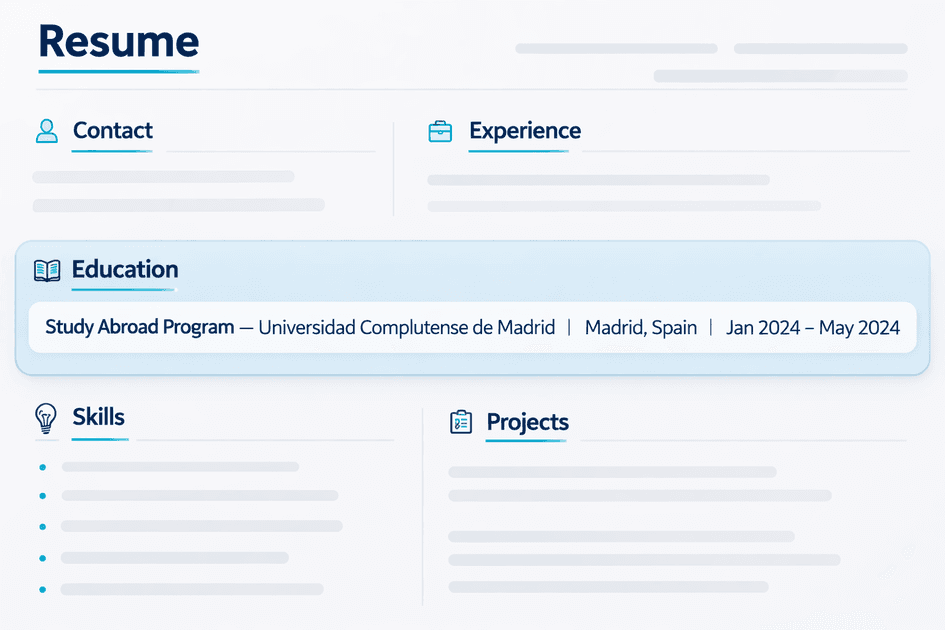
Most people who studied abroad bury it — one line under a university name, no context, no skills, no story. Recruiters scan past it in two seconds. That's a real problem, because a semester in Barcelona or Tokyo, done right, can do more work on a resume than a lot of internships.
Knowing how to include study abroad on a resume correctly is the whole game.
TL;DR
To include study abroad on a resume, list it in your Education section for most roles, add a separate International Experience section if the role is globally focused, and always name the institution, location, dates, and at least one transferable skill or outcome.
Where to Put Study Abroad on a Resume
There's no single right answer — it depends on where you are in your career.
Student or new grad with limited work experience: Put it in the Education section, directly under your home university. This is where recruiters look first, and your study abroad program is a real academic credential.
Current student with an internship on the resume: Keep it in Education, but write one tight bullet underneath that names a relevant skill. Don't let it disappear behind the internship.
Experienced candidate (3+ years of work history): Pull it into a separate "International Experience" section only if the role you're targeting is global-facing — international sales, consulting, diplomatic work. For most corporate jobs, one clean line in Education is enough. Taking up half a page on a semester from seven years ago will cost you.
A few postings will ask for "relevant coursework" — that's a third option, but only use it if you took courses directly tied to the job. Language courses count. "Introduction to European History" probably doesn't.
How to Write Study Abroad on a Resume (Examples)
Two formats work. The first is for the Education section. The second is for when you want to show skills, not just dates.
Education section format:
Study Abroad Program — Universidad Complutense de Madrid | Madrid, Spain | Jan 2024 – May 2024
Experience-style bullet format (use this when you have something real to show):
- Completed 15-credit curriculum taught entirely in Spanish; maintained 3.6 GPA while managing coursework across three departments
- Coordinated a student group project with peers from six countries; delivered final presentation to faculty panel in a second language
The experience-style bullets work best when you actually did something measurable — a project, a language milestone, a leadership moment. If you went abroad and mostly traveled, stick to the one-line education format. Don't invent outcomes.
Skills You Can Highlight From Study Abroad
Listing "study abroad" and stopping there is the mistake. The skills are the point.
- Cross-cultural communication — you negotiated meaning with people who didn't share your assumptions - Language proficiency — name the language, be honest about level; "conversational Spanish" is fine, "fluent" when you're not will backfire - Adaptability — you figured out a healthcare system, a transit system, and a grading curve that weren't yours - Independent decision-making — no support network, real problems to solve, unfamiliar city - Academic performance under pressure — studying in a second language is harder than it looks on paper - Budget management — managing living expenses abroad on a fixed budget is a real skill for finance and ops roles
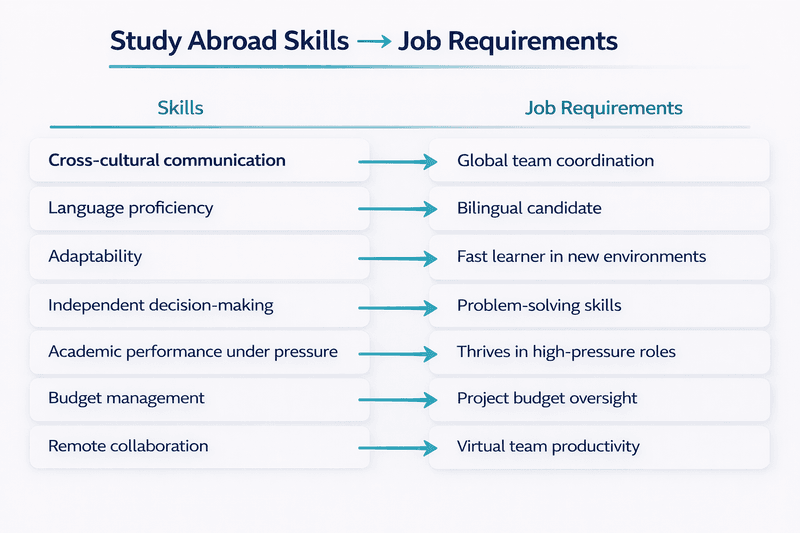
Only list what you can back up. A recruiter will ask for a story. Have one ready.
ATS Tips for Listing Study Abroad
ATS systems parse text mechanically. A few things trip them up:
- Use the full institution name first, then abbreviations. "Universidad Complutense de Madrid (UCM)" — not just "UCM." - Spell out the country or city explicitly. Some parsers drop foreign-language location names. Add "Spain" or "Japan" even if it feels redundant. - Keep dates in a consistent format across the whole resume. "Jan 2024 – May 2024" or "01/2024 – 05/2024" — pick one and don't mix them. - Don't lead with location alone. A line that says only "Madrid, Spain | 2024" tells the ATS nothing. Give it a program name or institution. - Avoid image-based resume formats if applying through a portal. The ATS reads text; graphics become invisible. - Save as PDF unless the posting says otherwise: FirstName-LastName-Resume.pdf.
Not sure if your resume is reading correctly? Upload your resume to resumescorer.com for a free ATS score.
Quick Checklist Before Submitting Your Resume
- [ ] Study abroad entry includes: program or institution name, city and country, exact dates - [ ] At least one bullet or note shows a real skill or outcome — not just "attended" - [ ] Language proficiency level is honest and specific ("intermediate written French," not "French") - [ ] Dates are formatted the same way throughout the whole document - [ ] File is saved as PDF, named correctly, under 1MB
FAQ
Does study abroad count as work experience? No — list it under Education. Only move it to Experience if you held a paying job, formal internship, or structured leadership role while abroad.
What if my study abroad was short — just one month? One month is worth listing if you can name a real skill or outcome. If it was a tour program with no academic credit, leave it off the resume and mention it in a cover letter or interview instead.
Should I list study abroad if it was years ago? If it's more than five years old and you've since built a real work history, one line in Education is enough. Don't dedicate bullets to it. The work experience should be carrying the resume by now.
Conclusion
Study abroad is an asset on a resume, but only if you write it like one. A program name and a date range won't do it. Name the institution, show the skill, be specific about what you actually did.
Upload your resume to resumescorer.com for a free score and personalized tips.
References: NAFSA: Association of International Educators; Institute of International Education (IIE) Open Doors Report
Written by
Rachel Torres, M.Ed.
Ready to Optimize Your Resume?
Put these strategies into action. Get your free ATS resume score in 2 minutes.
Check Your Resume NowResume Writing FAQ
How long should my resume be?
Most resumes should be one page for less than 10 years of experience, or two pages for more extensive careers. Focus on relevance over length.
What format is best for ATS systems?
ATS systems work best with simple, clean formats. Use standard fonts, clear section headings, and avoid tables, columns, and graphics. PDF is generally safe, but some older ATS prefer .docx.
How do I optimize my resume for keywords?
Match keywords from the job description naturally throughout your resume. Include them in your summary, experience bullets, and skills section. Use both abbreviated and full forms (e.g., 'SEO' and 'Search Engine Optimization').
Should I include a cover letter?
Yes, when possible. A tailored cover letter can differentiate you from other candidates and explain gaps, career changes, or specific qualifications that your resume alone may not convey.
Related Articles
Resume Examples for Receptionist: Ready-to-Use Templates
Nobody Cares What You Were Responsible For
What Nobody Tells You About Resumes
Explore more resume tips and career advice to improve your job search.